Most people are surprised when I tell them we can scan the heart with an MRI. "Isn't that just for the brain and spine?" they ask.
Cardiac MRI is regarded as the gold standard for detailed heart imaging. Unlike echocardiogram (echo) or CT, it provides high-resolution pictures of heart muscle, valves, and vessels without radiation. But it's specialized—not every center offers it, and not every heart problem needs it.
Let me explain what makes cardiac MRI special, who needs it, and how it compares to other heart tests.
What Does Cardiac MRI Detect?
In my practice at Magnus Diagnostics, cardiac MRI excels at showing things other tests can't see clearly:
Heart Muscle (Myocardium)
- Cardiomyopathy (dilated, hypertrophic, restrictive)—when the heart muscle is diseased
- Myocarditis (heart muscle inflammation)—often missed by other tests
- Scar after heart attack (infarction)—shows which areas are permanently damaged
- Viability: which damaged muscle might recover with treatment—crucial for deciding on procedures
This is where cardiac MRI shines. Echo shows function, but MRI shows tissue quality. I've seen patients whose echo was "normal" but cardiac MRI revealed significant scarring—information that changed their treatment plan.
Valve Disease
- Valve structure and function
- Regurgitation and stenosis severity
- Planning for valve repair or replacement
When surgeons need precise measurements before operating, cardiac MRI gives them what they need.
Congenital Heart Disease
- Complex defects in children and adults
- Pre- and post-surgery assessment
For congenital heart disease, cardiac MRI is often the best way to see the full picture—especially in adults who had surgery as children and need follow-up.
Tumors and Masses
- Benign and malignant heart tumors
- Pericardial disease
Heart tumors are rare, but when we suspect them, cardiac MRI is the test of choice.
Vascular
- Aortic aneurysm and dissection
- Coarctation and other vessel anomalies
Cardiac MRI vs Echocardiogram (Echo)
Both Echo and Cardiac MRI use no radiation, but they differ significantly in their capabilities. Echo is fast, taking 15-30 minutes, and is excellent for routine assessment of heart function, blood flow, and valves. It's widely available and more affordable. Cardiac MRI takes longer—45-90 minutes—but provides superior detail of heart muscle, scar tissue, and tissue characterization that Echo cannot match. However, Cardiac MRI costs more and is available at fewer specialized centers.
Echo is fast, portable, and excellent for routine function and flow. Cardiac MRI adds precise tissue characterization—scar, fibrosis, and structural detail—when echo or other tests are inconclusive.
In my practice, I use echo first for most patients. But when we need more detail—especially about heart muscle health—cardiac MRI is the next step.
Cardiac MRI vs CT Coronary Angiogram
Cardiac MRI uses no radiation and excels at assessing heart muscle, valves, and scar tissue, sometimes using gadolinium contrast when needed. CT Coronary Angiogram uses X-rays to visualize coronary artery blockages and typically requires iodine contrast. They answer different clinical questions: if you're concerned about blocked arteries, CT angiogram is usually the better choice, while Cardiac MRI is superior for evaluating heart muscle disease, myocarditis, and structural heart problems.
- Cardiac MRI: Best for cardiomyopathy, myocarditis, valve disease, congenital disease.
- CT Angiogram: Best for suspected coronary artery blockage.
They answer different questions. If you're worried about blocked arteries, CT angiogram is usually better. If you're worried about heart muscle disease, cardiac MRI wins.
Who Needs a Cardiac MRI?
Cardiac MRI is typically ordered when:
- Echo is unclear or suggests a structural problem—we need better images
- Heart failure cause is uncertain (e.g., cardiomyopathy vs ischemic)—MRI helps distinguish
- Myocarditis or heart muscle inflammation is suspected—often missed by other tests
- Congenital heart disease needs detailed mapping—especially complex cases
- Valve disease requires precise assessment before surgery—surgeons need exact measurements
- Cardiac mass or tumor is seen or suspected—MRI shows tissue characteristics
- Scar or viability needs to be assessed after heart attack—decides if procedures will help
I don't order cardiac MRI for routine heart checks. It's reserved for cases where we need that extra level of detail.
Preparation for Cardiac MRI
When you come to our centre for cardiac MRI:
- Fasting: Usually not needed; follow center instructions
- Medications: Take as usual unless your doctor says otherwise
- Breathing: You may be asked to hold breath for short periods—this helps image quality
- Metal: No pacemakers (unless MRI-conditional), aneurysm clips, or other incompatible devices
Most patients tolerate it well. The hardest part is holding your breath during certain sequences—but it's only for 10-15 seconds at a time.
What to Expect During the Procedure
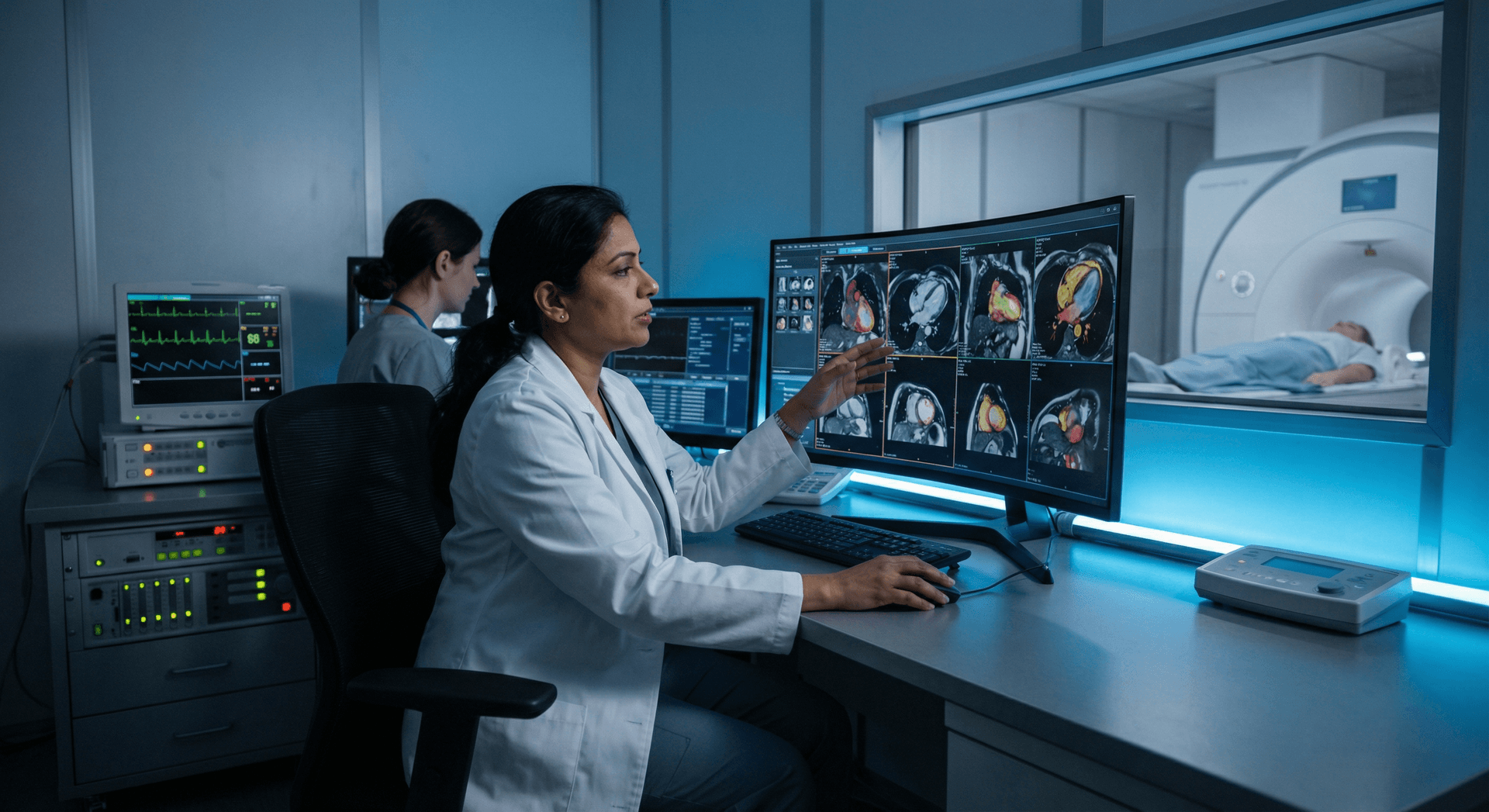
- You lie on your back; ECG leads are placed for gating—the machine synchronizes with your heartbeat
- Duration: about 45–90 minutes—longer than regular MRI, but necessary for heart imaging
- You must lie still; breath-holding helps image quality
- Headphones reduce noise; you can talk to the staff via microphone
- Contrast may be given partway through if needed—helps see scar and viability
It's longer than a regular MRI, but the information we get is worth it. I always explain this to patients upfront—they need to be prepared for the time commitment.
Cardiac MRI Cost in Kerala
Cardiac MRI is a specialized study. In Kerala, it typically costs ₹12,000–₹25,000 depending on the center and protocol.
Magnus Diagnostics North Paravur is one of the few centers in Kerala offering Cardiac MRI. We use AI-enabled 1.5T MRI at our Don Bosco Hospital campus in North Paravur, Ernakulam.
Summary
Cardiac MRI is the gold standard for assessing heart muscle, valves, and congenital disease. It uses no radiation and provides information that echo and sometimes CT cannot. At Magnus Diagnostics, we offer Cardiac MRI at our North Paravur center.
If your doctor has recommended cardiac MRI, it's because they need detailed information about your heart. Call +91 62350 05007 for North Paravur or visit our MRI services page to learn more. We're one of the few centers in Kerala that can provide this specialized imaging.