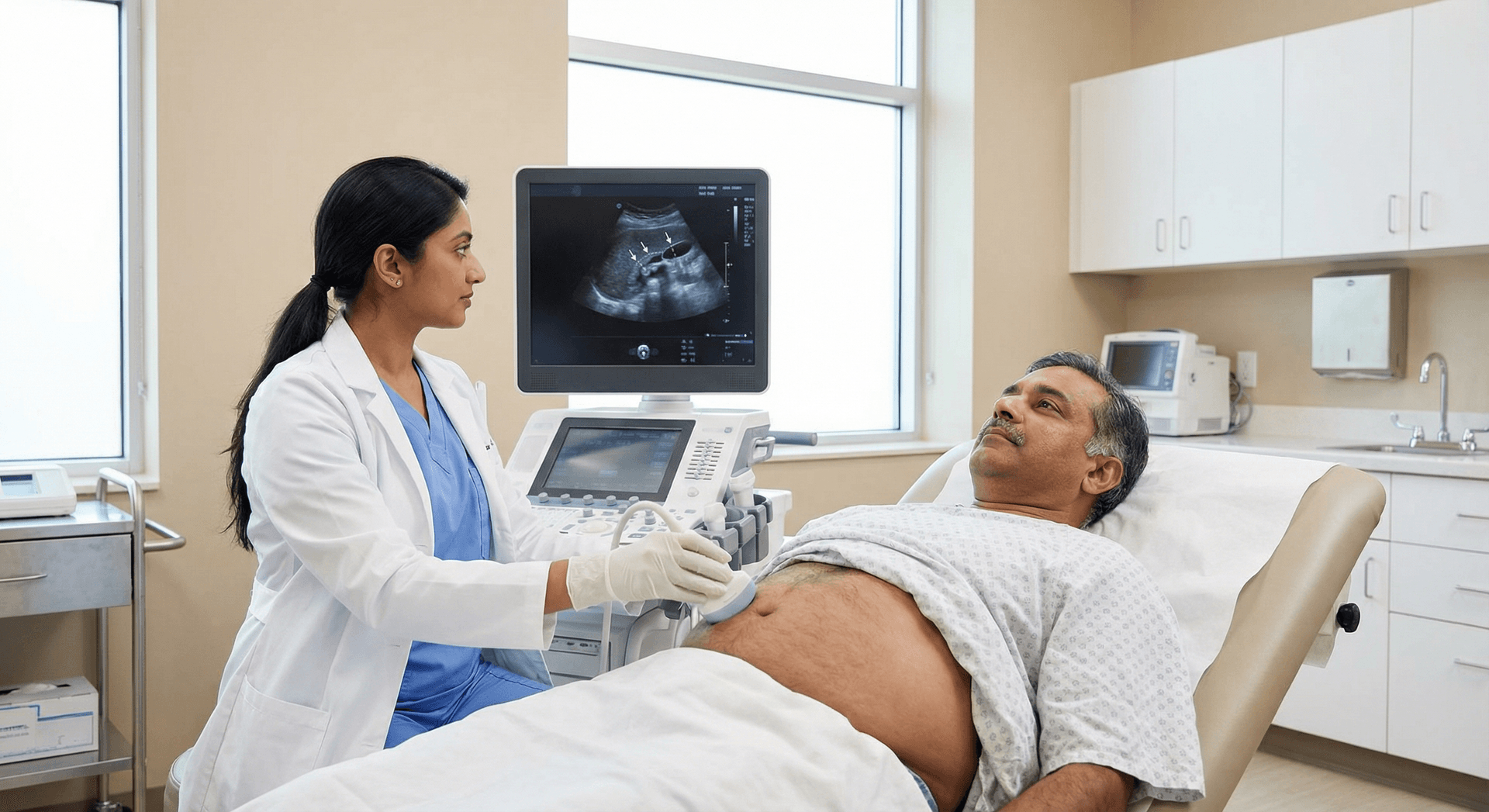
If your doctor has told you that you have a "fatty liver," you're definitely not alone. In my experience, this is the single most common incidental finding on abdominal ultrasounds in Kerala. Patients come in for a routine checkup, we do an ultrasound, and there it is—fatty liver.
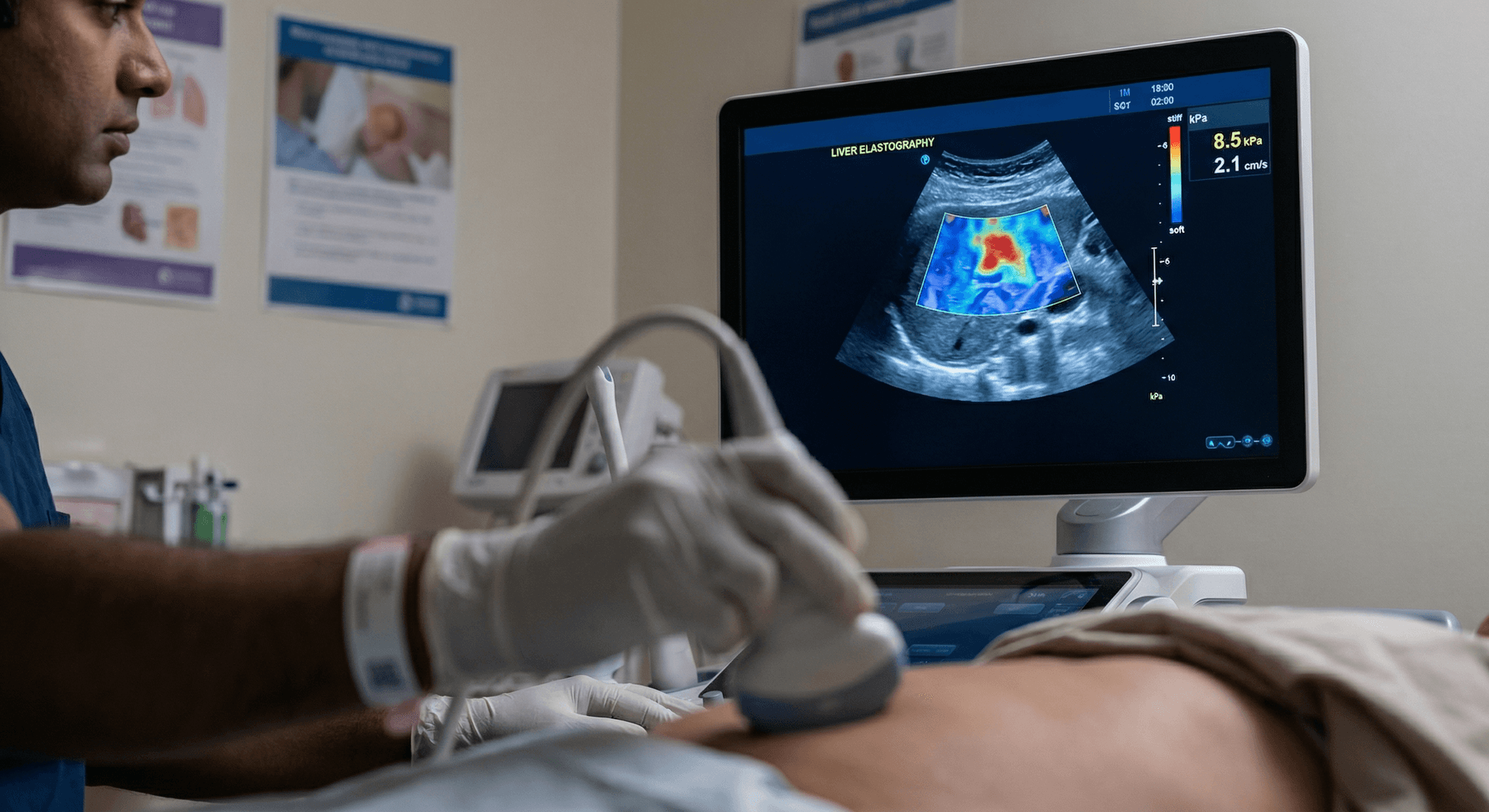
The next question is always: "Is it serious? Do I need a biopsy?" The good news? We can check for liver scarring—fibrosis—without a single needle. That's what elastography does. It measures how stiff your liver is, which tells us if there's scarring, all in about 10 minutes, completely painless.
At Magnus Diagnostics, we use Shear Wave Elastography—a technology that's integrated into our high-end ultrasound machine. Let me explain how it works, and why it might be better than the older Fibroscan method.
What Are Liver Stiffness Tests, and Why Do We Need Them?
Your liver can become stiff when scar tissue—fibrosis—builds up from inflammation. This happens with fatty liver disease, hepatitis, alcohol use, or other causes. Left unchecked, fibrosis can progress to cirrhosis—serious liver damage that's hard to reverse.
Traditionally, checking for fibrosis meant a liver biopsy—a needle through your skin, into your liver, to take a tiny sample. It works, but it's invasive, has risks, and only samples a small part of the liver.
Elastography changed everything. It measures liver stiffness non-invasively—no needles, no recovery time, results in minutes. Stiff liver means fibrosis. Soft liver means healthy tissue. It's that simple.
Fibroscan vs Shear Wave Elastography: How They Work
Both tests measure liver stiffness, but they do it differently.
Fibroscan (Transient Elastography)
Fibroscan uses a dedicated machine—separate from routine ultrasound. A vibrating probe sends a shear wave through your liver, and the machine measures how fast it travels. Stiffer liver = faster wave = more fibrosis.
Limitations I've seen:
- Fixed measurement path—less control over exactly where we measure
- Can fail in obese patients or those with narrow rib spaces
- Separate machine—you might need two appointments (one for imaging, one for elastography)
- Optional CAP (Controlled Attenuation Parameter) for fatty liver—not always included
Shear Wave Elastography (What We Use)
Shear Wave Elastography is built into high-end ultrasound machines—like our GE LOGIQ E10, which is India's first. The ultrasound probe generates shear waves, and we measure how fast they travel to calculate stiffness.
Why I prefer it:
- Targeted measurement: I can choose exactly where to measure—avoiding blood vessels, masses, or areas that might give false readings
- Imaging + stiffness in one: We see the liver with ultrasound and measure stiffness in the same session
- Fatty liver grading: We can assess steatosis (fatty liver grade) at the same time
- Better in obesity: Often works when Fibroscan fails
- More control: I can adjust the region of interest based on what I see
When You Need a Liver Stiffness Test
In my practice, I recommend elastography for several situations:
Fatty Liver (NAFLD): This is the most common reason. If you have obesity, diabetes, metabolic syndrome, or elevated liver enzymes, we check for fibrosis. Fatty liver itself isn't necessarily dangerous, but if it progresses to fibrosis or cirrhosis, that's serious. Elastography tells us where you are on that spectrum.
Hepatitis B or C: Chronic hepatitis can cause fibrosis over time. We use elastography to stage the disease—how much scarring is there?—and to monitor treatment response. If antiviral treatment is working, stiffness should decrease.
Alcohol-Related Liver Disease: Regular or heavy alcohol use can cause fibrosis. Elastography helps us assess the damage and guide management. Sometimes seeing the number—the actual stiffness—is what motivates patients to cut back or quit.
Other Causes:
- Drug-induced liver injury
- Autoimmune hepatitis
- Unexplained elevated liver enzymes (ALT/AST)
- Family history of liver disease
The test is painless, takes 10–15 minutes, and gives us answers without a biopsy.
What Your Results Mean: Understanding the Numbers
Elastography results are expressed in kPa (kilopascals) or m/s (meters per second). Your report will also include a fibrosis stage:
F0–F1 means no or mild fibrosis—minimal scarring that's usually reversible with lifestyle changes like weight loss, diet modification, and avoiding alcohol. F2 indicates moderate fibrosis with some scarring that needs monitoring and treatment to prevent progression. F3 means severe fibrosis with significant scarring and a high risk of progressing to cirrhosis if not managed aggressively. F4 is cirrhosis—advanced scarring that requires specialist management and careful monitoring.
Fatty Liver (Steatosis) Grading:
- Grade 0: Normal (no fatty liver)
- Grade 1–3: Mild to severe fatty liver
These numbers help your doctor decide on treatment and follow-up. Early fibrosis (F0–F1) can often be reversed with lifestyle changes—weight loss, diet, exercise, avoiding alcohol. Advanced fibrosis (F3–F4) needs more aggressive management and specialist care.
Why We Use Shear Wave Elastography at Magnus
At Magnus Diagnostics, we use Shear Wave Elastography on India's first GE LOGIQ E10 system. Here's why I chose this technology:
Targeted Measurement: I can select the best area to measure—avoiding blood vessels, masses, or artifacts that might give false readings. This gives us more accurate results.
Imaging + Stiffness: We see the liver with high-resolution ultrasound and measure stiffness in one session. If I see something suspicious on imaging, I can measure stiffness right there.
Fatty Liver Grading: We can assess both fibrosis and steatosis (fatty liver) in the same test. One appointment, complete liver assessment.
Wider Applicability: Shear Wave Elastography often works in overweight and obese patients where Fibroscan might fail. In Kerala, where obesity rates are rising, this matters.
No Biopsy Needed: Painless, non-invasive, results in minutes. No needles, no recovery, no risks.
Preparation: What to Expect
Fasting: This is important. You need to fast for at least 6 hours before the test. Food affects liver stiffness—eating can temporarily increase it, giving false readings. Fasting ensures accurate results.
Procedure: You'll lie on your back. I'll apply gel to your upper abdomen and place the probe on your skin. The machine sends shear waves through your liver and measures how fast they travel. Takes about 10–15 minutes. Minimal discomfort—just pressure, like a regular ultrasound.
Results: Typically available the same day. I'll explain what the numbers mean and discuss next steps with you.
Elastography Cost at Magnus Diagnostics
At our centres, Shear Wave Elastography costs ₹2,500—that's our offer price (regular ₹3,500) for a limited time.
Available at Irinjalakuda and North Paravur. Book in advance—we need to schedule these tests to ensure proper fasting and adequate time.
The Bottom Line
If you have fatty liver, hepatitis, or alcohol-related concerns, elastography can check for fibrosis without a biopsy. It's painless, non-invasive, and gives results in minutes.
At Magnus, we use Shear Wave Elastography—a technology that gives us more control, better imaging integration, and often works better in obese patients. We can assess both fibrosis and fatty liver in one test.
The numbers tell us where you are on the spectrum—from healthy liver to cirrhosis—and guide treatment. Early fibrosis can often be reversed. Advanced fibrosis needs specialist care. Either way, knowing is better than guessing.
Ready to check your liver? Call us at +91 89031 01010 or visit our Liver Elastography page. We're here to help you understand your liver health, without the needles.