Headaches are universal. Whether it is a thumping migraine after a sleepless night or a dull ache from staring at screens, almost everyone in Kerala deals with them.
In my practice at Magnus Diagnostics, "severe headache" is one of the most common reasons patients walk through our doors asking for a scan.
But here is the truth: Most headaches do not need a scan.
However, there are specific "Red Flags" where a scan isn't just recommended—it could be life-saving. And the big question is always: Should I get a CT or an MRI?
Let's clear up the confusion.
The "Red Flags": When to Worry
If you have had the same type of tension headache for 10 years, it is rarely a brain tumor. We worry when the pattern changes.
Seek medical help immediately if:
- The "Thunderclap": A sudden, severe headache that hits maximum intensity in seconds (like being hit by a cricket bat).
- New Onset Over 50: You never had headaches before, and now you do.
- Morning Headaches: Waking up with a headache that gets better after you stand up.
- Neurological Signs: If the pain comes with vision loss, weakness, or slurred speech.
CT vs MRI: Which One Do You Need?
Ideally, your Doctor or Neurologist decides this. But here is the general rule of thumb we use in Radiology:
1. The CT Scan (Computed Tomography)
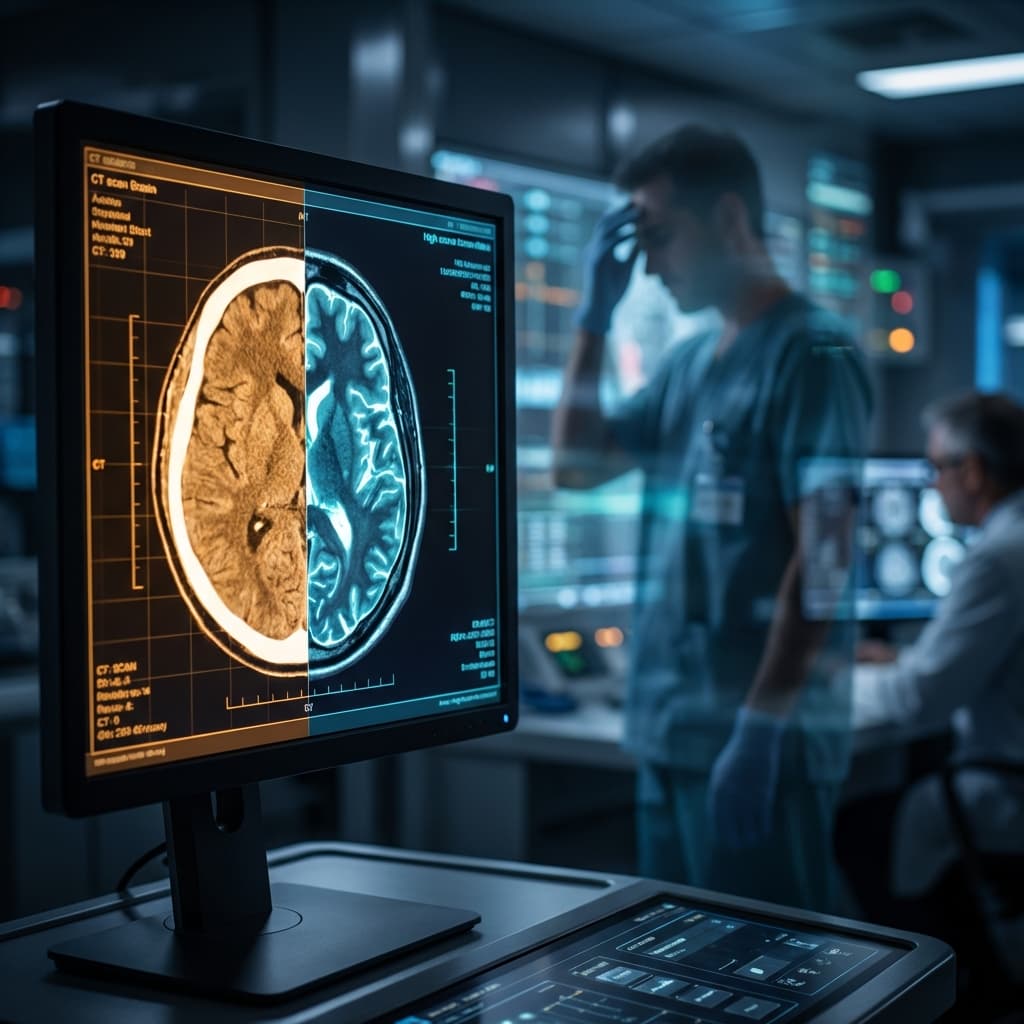
Think of the CT scan as the "Emergency Room Specialist". It uses X-rays to create a 3D image.
- Best For:
- Bleeding: It is incredibly fast at detecting fresh blood (hemorrhage) from a burst aneurysm or stroke.
- Trauma: If you fell and hit your head, a CT quickly checks for skull fractures.
- Speed: A CT Brain takes less than 2 minutes.
- The Downside: It uses radiation (though minimal) and isn't great at showing detailed soft tissue like early tumors or inflammation.
2. The MRI (Magnetic Resonance Imaging)
Think of the MRI as the "Deep Dive Detective". It uses magnets (no radiation) to show incredible detail.
- Best For:
- Tumors: Even tiny growths are visible.
- Chronic Headaches: If you have had pain for months, MRI helps rule out structural issues, sinus problems, or nerve compressions.
- Infections: Meningitis or other deep brain infections.
- The Downside: It takes longer (15–20 minutes) and is more expensive than a CT.
What Usually Happens?
If you come to our centre in Thrissur with a "worst headache of my life" scenario, we might prioritize a CT Brain just to rule out a bleed quickly.
But for almost everything else—lingering migraines, dizziness, or brain fog—an MRI Brain is the gold standard. It gives us a complete map of your brain health without any radiation risk.
Patient FAQ
"I have migraines. Do I need a scan?"
Usually, no. Migraines have very specific symptoms (aura, light sensitivity). However, if your migraine pattern changes drastically, a Neurologist might order an MRI just to be safe.
"Is the contrast dye safe?"
For headaches, we often do a "plain" scan first. If we see something suspicious, we might ask your permission to inject contrast. Modern MRI contrast (Gadolinium) is very safe for most people with healthy kidneys.
The Bottom Line
Don't Google your symptoms until you panic.
- Trust your instinct: If a headache feels "wrong" or different, see a doctor.
- Don't demand a CT: Let the doctor decide. Often, an MRI is the safer, more detailed choice for long-term issues.
🏥 Magnus Diagnostics
We perform both High-Speed CT and High-Field MRI scans daily.
📍 Find Your Nearest Centre | 📞 Call for Advice: +91 89031 01010
Related Reading
Book your diagnostic test at Magnus Diagnostics — Kerala's most trusted diagnostic center.