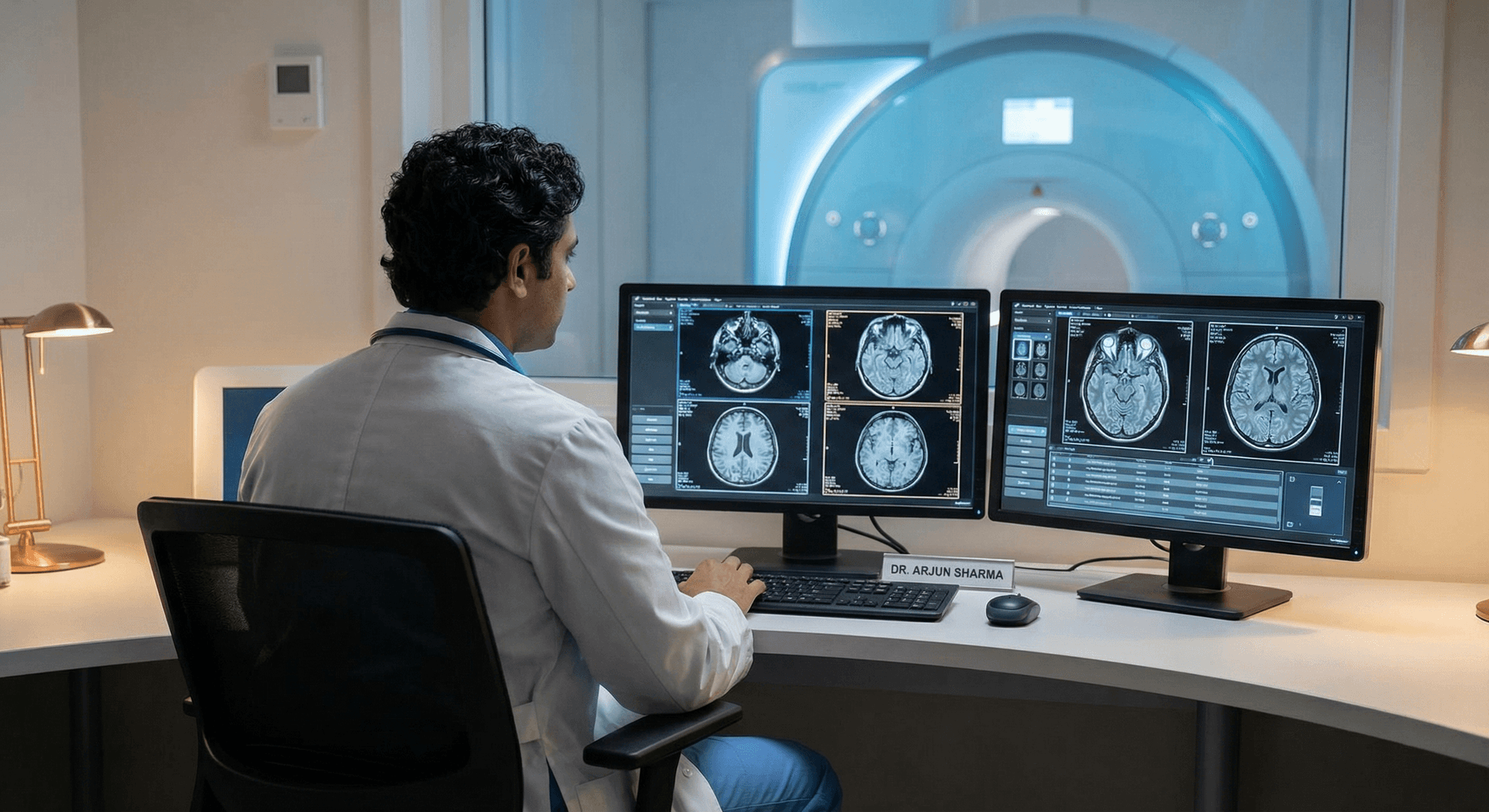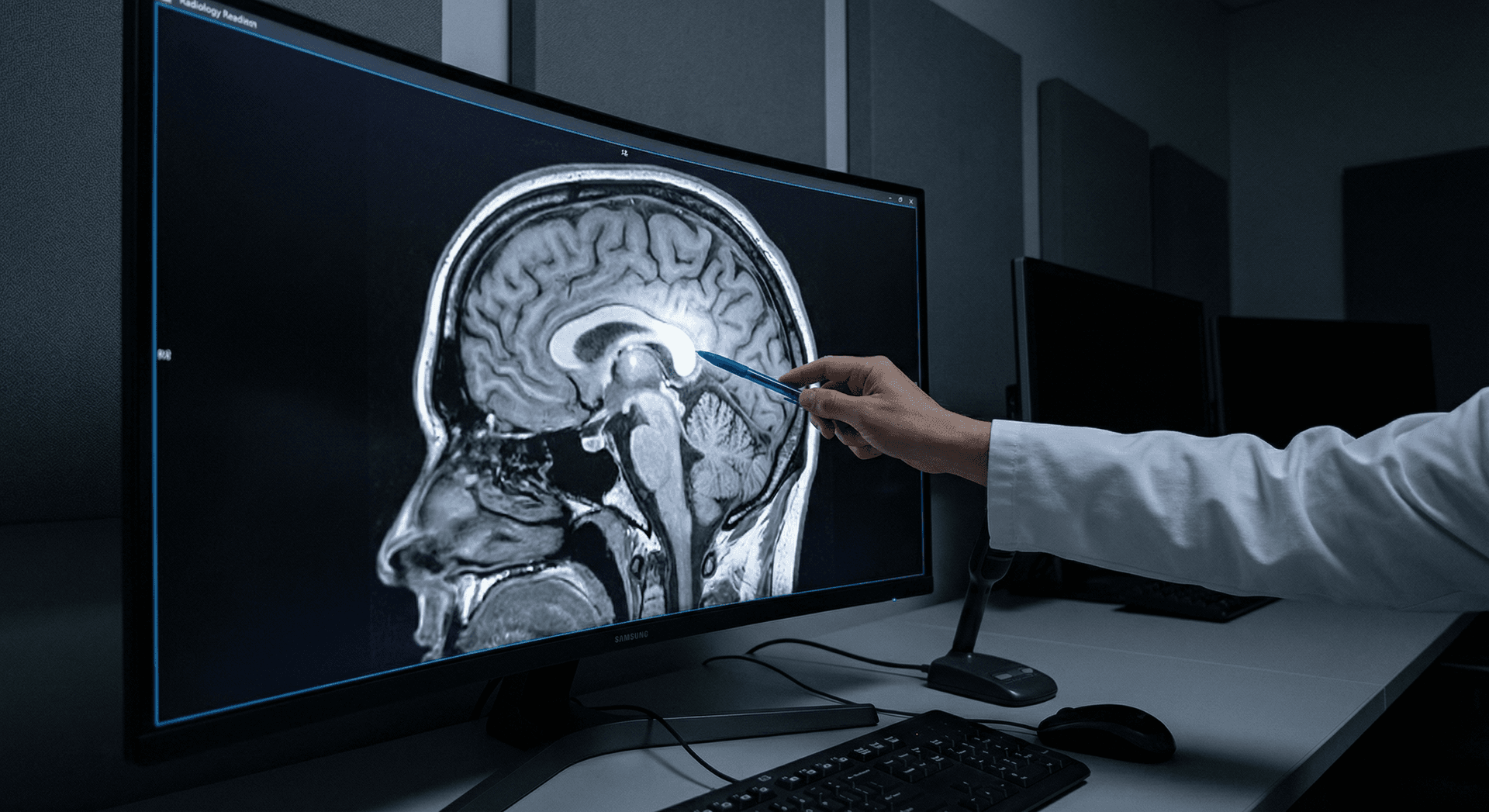
Almost every week, someone walks into our Irinjalakuda centre saying "Doctor, I need a brain scan."
Sometimes they're right—they do need it. Sometimes they've been Googling symptoms and convinced themselves of the worst. Sometimes their family doctor has wisely referred them for clarity.
A brain MRI is one of the most powerful tools in modern medicine for viewing the brain without surgery. But here's what I tell every patient: don't Google your symptoms until you panic. Let me explain when you actually need a brain MRI, what to expect, and what it can—and can't—tell us.
When Do Doctors Recommend a Brain MRI?
In my practice at Magnus Diagnostics, I order brain MRI for many reasons. Here are the most common scenarios I see:
Headaches
Chronic or worsening headaches that don't respond to usual treatment are one of the most common reasons patients walk through our doors. But not every headache needs a scan. I order brain MRI when:
- The pattern changes suddenly
- There's a new-onset severe headache (thunderclap) to rule out bleeding or aneurysm
- Migraine patterns shift or other symptoms appear
If you've had tension headaches for years and they're the same, we usually don't need a scan. But if something feels different, that's when I recommend imaging.
Seizures and Epilepsy
First-time seizure? We need to look for structural causes—tumors, scar, malformation. Poorly controlled epilepsy? We might need imaging to guide surgery or further treatment. This is one area where MRI is essential, not optional.
Suspected Stroke or TIA
After a transient ischemic attack (TIA) or "mini-stroke," we scan to find damage or risk. Follow-up after ischemic stroke helps us see the extent of injury and guide prevention. If you come to our centre in Thrissur or Ernakulam with stroke symptoms, we prioritize these scans.
Tumors
When symptoms suggest a brain tumor—headaches, seizures, weakness, vision changes—we scan. We also monitor known tumors before or after treatment. This is where contrast MRI becomes crucial.
Memory Loss and Dementia
Unexplained memory loss or confusion needs investigation. I always tell patients: we need to rule out treatable causes (normal pressure hydrocephalus, tumor) before assuming dementia. Don't accept "it's just aging" without a proper workup.
Dizziness and Balance
Persistent dizziness, vertigo, or balance issues—when inner ear causes are excluded—need brain imaging. We check the brainstem and cerebellum, areas that control balance.
Vision or Hearing Changes
Sudden vision loss, double vision, or visual field defects? Unexplained hearing loss when ear causes are ruled out? These warrant brain MRI.
Head Injury
Moderate to severe head injury with ongoing symptoms needs imaging. When CT is inconclusive but symptoms persist, MRI gives us the detail we need.
At Magnus Diagnostics, we perform brain MRI with AI-enabled 1.5T scanners at our Irinjalakuda and North Paravur centers.
What Can a Brain MRI Detect?
When I review brain MRI scans, I'm looking for:
- Tumors (benign and malignant)
- Stroke (acute and old)
- Aneurysms and vascular malformations
- Multiple sclerosis (MS) plaques
- Hydrocephalus (fluid buildup)
- Infections (abscess, meningitis)
- Structural anomalies (congenital)
- Bleeding (subarachnoid, subdural, intracerebral)
- Brain atrophy (shrinkage) seen in dementia
What I see on scans helps guide treatment decisions. Sometimes the scan is reassuring—nothing serious. Sometimes it reveals something that needs immediate attention. Either way, clarity helps.
Preparation: What to Do Before Your Brain MRI
Usually No Special Preparation
You can eat normally and take your regular medicines. No fasting required for routine brain MRI—I always reassure patients about this because many worry unnecessarily.
Metal and Implants
Remove jewellery, hairpins, watches, hearing aids, dentures. Inform staff about pacemakers, cochlear implants, aneurysm clips, or any metal in your body. Most modern implants are MRI-compatible; the team will verify. Don't assume you can't have MRI—ask us.
Clothing
Wear comfortable clothes without metal (zippers, snaps, underwire). You may be given a gown.
Claustrophobia
Our wide-bore MRI is more spacious than standard tunnels. A relative can stay in the room with you. Sedation can be arranged if needed—mention this when you book. I've helped many claustrophobic patients through this; we have solutions.
The Brain MRI Procedure: What to Expect
Here's what happens when you come to our centre:
- Check-in: You'll answer questions about metal implants and pregnancy
- Positioning: You lie on your back on the table; your head rests in a holder
- Ear protection: You receive earplugs or headphones; the scanner makes loud knocking sounds
- Stillness: You must lie very still for 20–30 minutes (or up to 45 with contrast)
- Communication: You can talk to the technician via microphone; they'll guide you
- Contrast (if used): A small IV is placed; contrast is injected partway through the scan
The key is staying still. I tell patients: think of it as meditation time. Some even fall asleep.
Contrast vs Non-Contrast Brain MRI
Non-Contrast (Routine)
Standard for most headaches, seizures, stroke follow-up, dementia. No injection; shorter and simpler. This is what most patients get.
With Contrast (Gadolinium)
Used when doctors need to see tumors, infection, MS lesions, or blood-brain barrier breakdown. Contrast highlights abnormal tissue. Generally very safe; rarely, patients with severe kidney disease need special caution.
Your referring doctor decides whether contrast is needed based on your condition. I only use it when necessary—it adds cost and time, but sometimes it's essential for diagnosis.
How Long Does a Brain MRI Take?
- Without contrast: About 20–30 minutes
- With contrast: About 30–45 minutes
- AI-enabled scanners: Can reduce time by roughly 30%
At Magnus, our AI-enabled machines are faster. Patients appreciate this—less time in the tunnel means less anxiety.
Is Brain MRI Safe?
Yes. Brain MRI:
- Uses no ionizing radiation (unlike CT or X-ray)
- Uses magnetic fields and radio waves
- Is safe for children and pregnant women (after the first trimester)
- Is painless; you only need to lie still
I reassure parents and pregnant patients about this regularly. MRI is one of the safest imaging tests we have.
Brain MRI Cost in Kerala
Brain MRI in Kerala typically costs ₹4,500–₹8,000 depending on the center and protocol. At Magnus Diagnostics, we offer:
- Routine Brain MRI: ₹7,000 (AI-enabled 1.5T)
- Stroke Screening MRI: ₹3,500 on Sundays and holidays
Summary
A brain MRI helps diagnose headaches, seizures, stroke, tumors, memory loss, and many other brain conditions. It uses no radiation, is safe for most people, and usually requires no special preparation. At Magnus Diagnostics, we provide AI-enabled brain MRI at Irinjalakuda and North Paravur.
If you need a brain MRI, don't delay. Call +91 89031 01010 or visit our MRI services page to schedule your scan. We're here to give you the clarity you need.