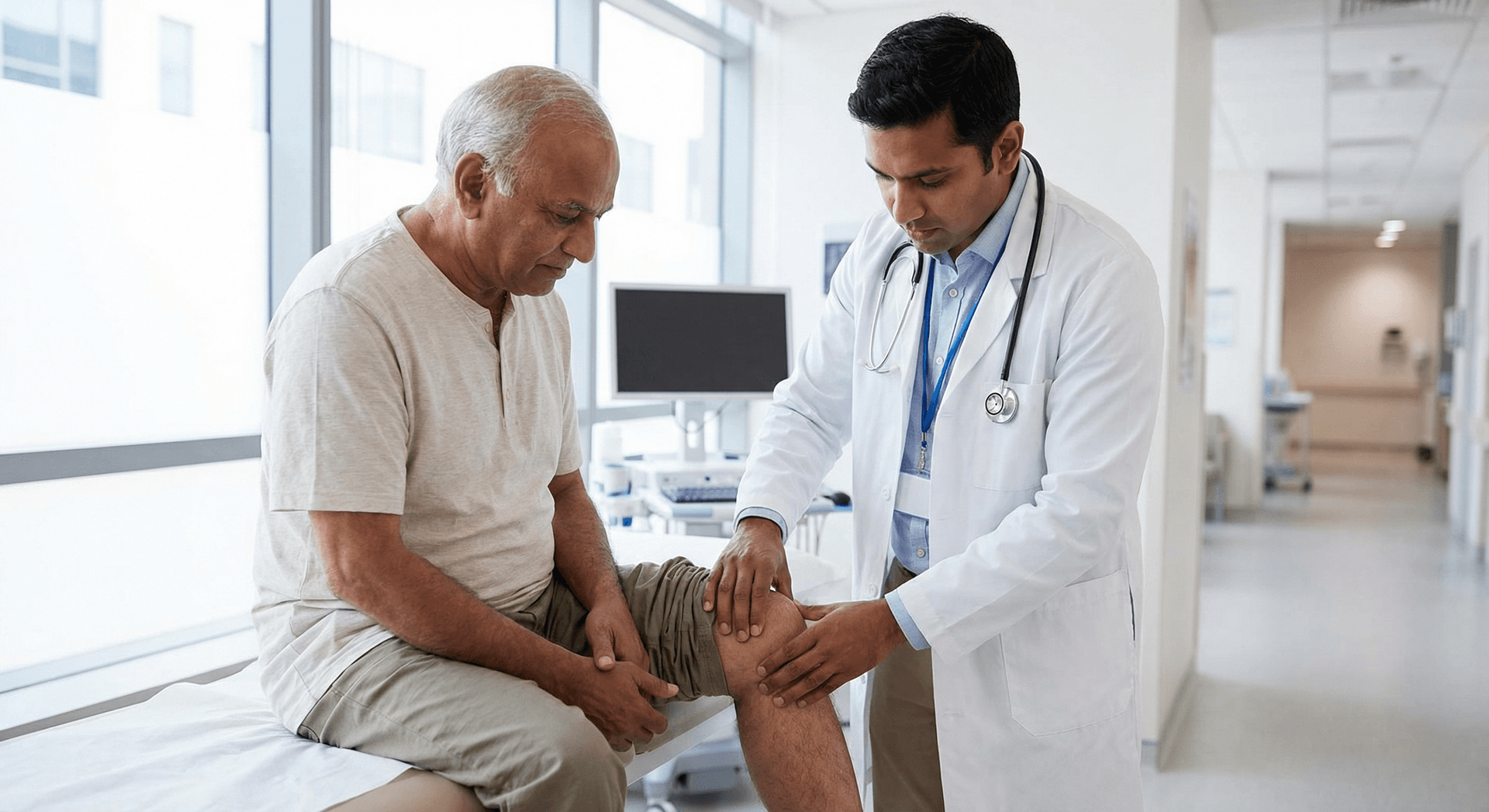
Knee injuries are incredibly common in Kerala—from weekend cricket players to elderly patients with arthritis. In my practice at Magnus Diagnostics, knee pain is one of the most frequent reasons patients come in.
When pain doesn't improve with rest and basic treatment, doctors often recommend a knee MRI to see ligaments, meniscus, and cartilage that an X-ray cannot show. But here's what I tell patients: not every knee pain needs an MRI. Let me explain when it's truly needed and what we can learn from it.
When Do Doctors Recommend a Knee MRI?
In my practice, I order knee MRI for:
- Sports or activity-related injury with swelling, popping, or giving way—I see this a lot with cricket and football players
- Suspected ligament tear (ACL, PCL, MCL, LCL)—when the knee feels unstable
- Meniscus tear (locking, catching, or deep knee pain)—common in patients who squat frequently
- Persistent pain that doesn't improve after 4–6 weeks—this is when we need to look deeper
- Pre-surgery planning (e.g., before ACL reconstruction)—surgeons need detailed images
- Arthritis workup when X-ray is normal but symptoms suggest cartilage damage—early arthritis shows on MRI before X-ray
- Baker's cyst or other soft-tissue masses—sometimes what feels like knee pain is actually something else
If you've just twisted your knee and it's been a day, we usually start with rest and X-ray. But if symptoms persist or worsen, that's when MRI becomes essential.
What Does a Knee MRI Show?
Knee MRI gives detailed images of structures X-ray can't see. When I review these scans, here's what I'm looking for:
Ligaments
- ACL (Anterior Cruciate Ligament): Common in sports; full vs partial tears. I see this frequently in young athletes.
- PCL (Posterior Cruciate Ligament): Less common; often from direct impact
- MCL & LCL: Collateral ligaments on the inner and outer knee—these can tear with side impacts
The scan shows tear location and severity, which helps decide if surgery is needed or if physiotherapy might work.
Meniscus
- Medial and lateral meniscus: Tears, degeneration, and extrusion
- Bucket-handle tears: Large tears that can lock the knee—these often need surgery
Meniscus tears are common, especially in patients over 40. Sometimes they're asymptomatic; sometimes they cause significant pain. MRI helps us understand which is which.
Cartilage
- Articular cartilage on femur, tibia, and patella
- Early arthritis before X-ray changes—this is where MRI is invaluable
I often tell patients: by the time arthritis shows on X-ray, it's advanced. MRI catches it early, when treatment can make a bigger difference.
Other Structures
- Tendons (patellar, quadriceps)
- Baker's cyst (fluid behind the knee)—often related to arthritis or meniscus issues
- Bone bruise (bone marrow edema)—common after injury, even when X-ray is normal
Knee MRI vs X-Ray: Why Both Matter
X-ray is excellent for bones, alignment, and fractures, taking just 1-2 minutes, but it uses radiation and cannot show soft tissues. Knee MRI, on the other hand, takes 25-40 minutes but uses no radiation and excels at showing ligaments, meniscus, and cartilage—structures that X-ray cannot visualize.
X-ray is good for fractures, arthritis (advanced), and alignment. MRI is needed for ligament tears, meniscus damage, and early cartilage disease. In my practice, I often start with X-ray—it's quick and cheap—but when symptoms suggest soft-tissue damage, MRI is the next step.
Preparation and What to Expect
When you come to our centre for knee MRI:
- No fasting required—eat normally
- Remove metal (jewellery, belts, keys)
- You lie on your back; your knee is placed in a coil
- Stay still for about 25–35 minutes
- Painless; you may feel some warmth in the knee
The hardest part is staying still. I tell patients: if your knee hurts, let us know. We can adjust positioning to make you more comfortable.
Common Knee MRI Findings
ACL Tear
Often from twisting or pivoting (football, basketball, cricket). The scan shows tear location and severity. I've seen many young athletes who thought they just "sprained" their knee—MRI revealed complete ACL tears that needed surgery.
Meniscus Tear
From twisting or squatting. Can cause locking, catching, or clicking. Sometimes small tears heal with rest; larger ones need surgery. MRI helps us decide.
Cartilage Damage
Worn or damaged cartilage (chondromalacia, osteoarthritis). Visible before X-ray changes. This is where early intervention—weight loss, physiotherapy, injections—can slow progression.
Baker's Cyst
Fluid-filled swelling behind the knee. Often related to arthritis or meniscus issues. Sometimes treating the underlying problem resolves the cyst.
Knee MRI Cost in Kerala
Knee MRI in Kerala usually costs ₹4,500–₹8,000. At Magnus Diagnostics, AI-enabled 1.5T Knee MRI is ₹7,000 at Irinjalakuda and North Paravur.
Summary
Knee MRI is the standard way to assess ligament tears (ACL, PCL), meniscus damage, cartilage wear, and other soft-tissue problems. It uses no radiation and gives clearer detail than X-ray. At Magnus Diagnostics, we offer knee MRI at both our Kerala centers.
If you're dealing with persistent knee pain, don't ignore it. Call +91 89031 01010 or visit our MRI services page to schedule your scan at Irinjalakuda or North Paravur. Getting clarity on what's wrong is the first step to getting better.