This is probably the question I answer most often—from patients, from referring doctors, even from medical students.
If your doctor has advised an imaging test, you may wonder: MRI or CT scan? Both produce detailed images of the inside of your body, but they work differently and are best for different conditions.
Let me explain it with a simple metaphor: Think of the CT scan as the Emergency Room Specialist—fast, decisive, great at finding fractures and bleeding. Think of the MRI as the Deep Dive Detective—takes more time, but sees details CT can't, especially in soft tissues.
MRI vs CT Scan: Quick Overview
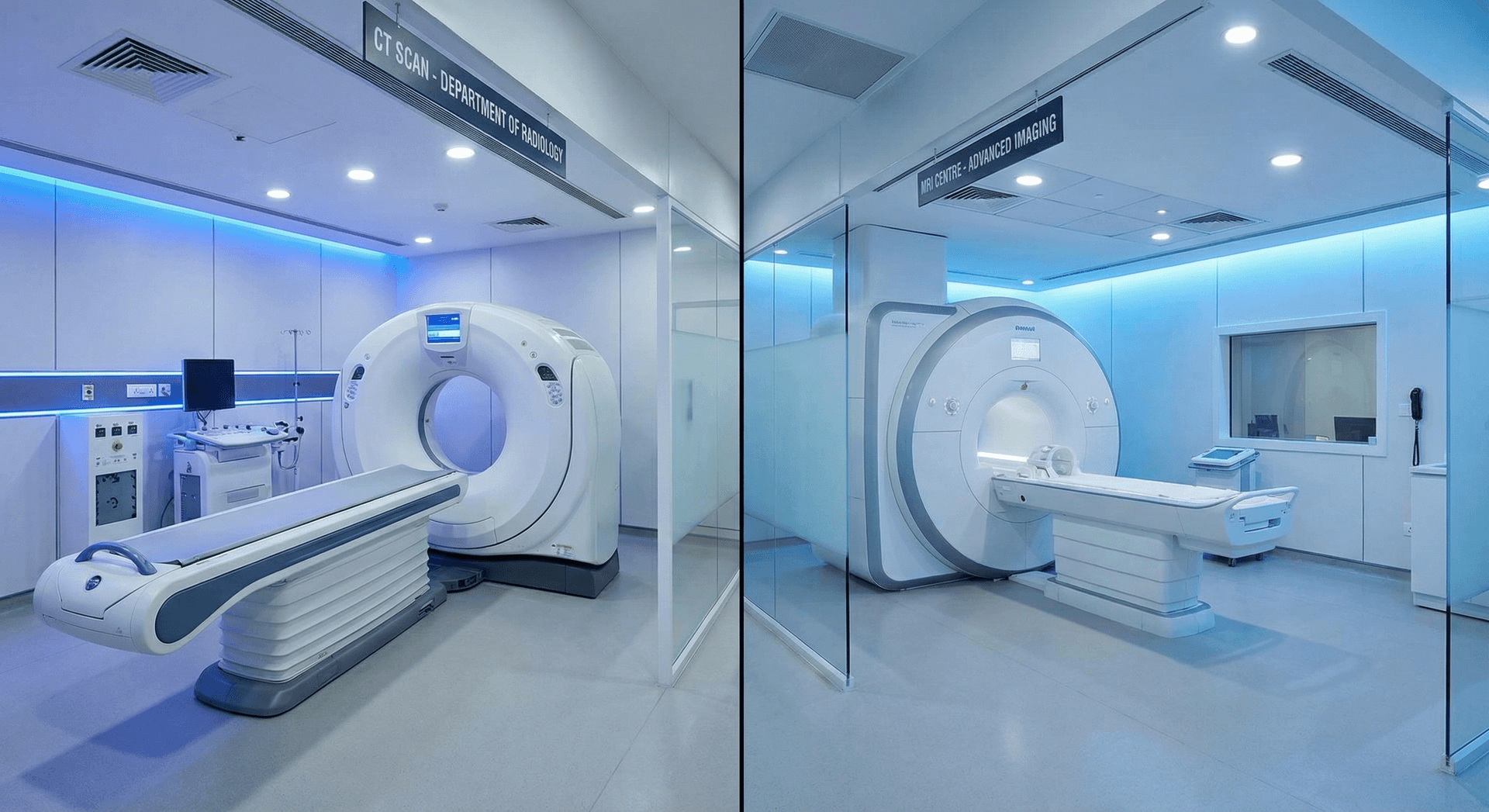
MRI uses magnets and radio waves with no radiation, making it safe for repeated scans and for children and pregnant women after the first trimester. It takes 20-45 minutes and excels at soft tissues like brain, spine, joints, and ligaments. However, claustrophobia can be an issue (though wide-bore machines help), and some metal implants may restrict or exclude its use. CT scan uses X-rays, takes just 1-5 minutes, and is better for bones, lungs, trauma, bleeding, and kidney stones. It's generally well-tolerated with minimal claustrophobia concerns, and metal implants usually don't exclude it. MRI is typically more expensive, while CT is usually more affordable.
When MRI Is the Better Choice
MRI uses no radiation and produces superb detail of soft tissues. In my practice at Magnus Diagnostics, I choose MRI when:
Brain and Nervous System
- Stroke (especially subacute and chronic)—MRI shows brain tissue damage better
- Brain tumors—superior detail for planning treatment
- Multiple sclerosis—MRI is the gold standard
- Seizures, epilepsy—finds structural causes
- Dementia workup—shows brain atrophy and patterns
- Pituitary gland—small structure, needs MRI detail
- Inner ear and nerves—CT can't see these well
Spine
- Disc herniation, bulge, stenosis—this is where MRI excels
- Nerve compression—shows exactly where nerves are pinched
- Spinal cord tumors—superior to CT
- Infection—better soft-tissue detail
Joints and Muscles
- Ligament tears (ACL, meniscus)—MRI is essential here
- Cartilage damage—sees it before X-ray changes
- Tendons and muscles—soft-tissue detail CT can't match
- Sports injuries—weekend cricket players, I see this a lot
Abdomen and Pelvis (Select Cases)
- Liver masses—characterization better with MRI
- Prostate—MRI-guided biopsies are becoming standard
- Uterus, ovaries—better for certain conditions
- MRCP (bile ducts, pancreas)—no radiation alternative to CT
Heart
- Cardiac MRI (heart muscle, valves, congenital defects)—gold standard
At Magnus Diagnostics, we offer AI-enabled 1.5T MRI at Irinjalakuda and North Paravur, including Stroke Screening MRI at ₹3,500 on Sundays.
When CT Is the Better Choice
CT is fast and excellent for denser structures. In my practice, I choose CT when:
Trauma and Emergencies
- Head injury (bleeding, fracture)—speed matters here
- Chest/abdominal trauma—quick assessment saves lives
- Acute stroke (to rule out bleeding)—we need to know immediately if it's bleeding or blockage
Bones and Lungs
- Fractures—CT shows them clearly and quickly
- Lung nodules, pneumonia, cancer—CT is the standard
- HRCT chest (interstitial lung disease)—specialized CT protocol
Abdomen
- Kidney stones—CT finds them fast
- Appendicitis—classic CT diagnosis
- Liver, spleen injury—trauma assessment
- Acute abdomen—when we need answers quickly
Vascular
- CT angiography (vessels, aneurysm, blockages)—shows blood vessels well
- Pulmonary embolism—life-threatening, needs quick diagnosis
Speed-Critical Situations
- Unstable patients—can't wait 30 minutes for MRI
- Acute bleeding—CT shows it immediately
- When MRI is contraindicated (pacemaker, metal)—CT is the alternative
Magnus Diagnostics offers Ultra Low Dose 64-slice CT at North Paravur and Pullur, with up to 40% lower radiation than older machines.
Radiation: Why It Matters
X-ray uses low radiation from a single exposure, while CT uses moderate to high radiation because it takes multiple X-ray slices—the dose varies depending on which body part is scanned. MRI uses no radiation at all, relying solely on magnets and radio waves. This makes MRI safer for children, pregnant women (after the first trimester), and for patients who need multiple follow-up scans over time.
CT exposes you to ionizing radiation. One CT is usually safe, but repeated scans increase cumulative dose. MRI has no radiation—safe for children, pregnant women (after first trimester), and repeat follow-ups.
I always explain this to patients: if you need multiple scans over time (like monitoring a tumor), MRI is safer. If it's a one-time emergency, CT's radiation is acceptable.
Cost Comparison: MRI vs CT
In Kerala, Brain MRI typically costs ₹4,500–₹8,000 (₹7,000 at Magnus), while Brain CT ranges from ₹3,000–₹6,000. Spine MRI costs ₹5,000–₹10,000 (₹7,000 at Magnus), and Abdomen CT ranges from ₹4,000–₹8,000. For joint imaging, Knee and Shoulder MRI cost ₹4,500–₹8,000 (₹7,000 at Magnus). Generally, MRI is more expensive due to longer scan times and higher equipment costs, but your doctor's choice should be based on clinical need rather than cost alone.
MRI is generally more expensive due to longer scan time, equipment cost, and no radiation. Your doctor's choice is based on clinical need, not cost alone. I've seen patients ask for the cheaper option, but sometimes that's not the right test.
Time and Comfort
-
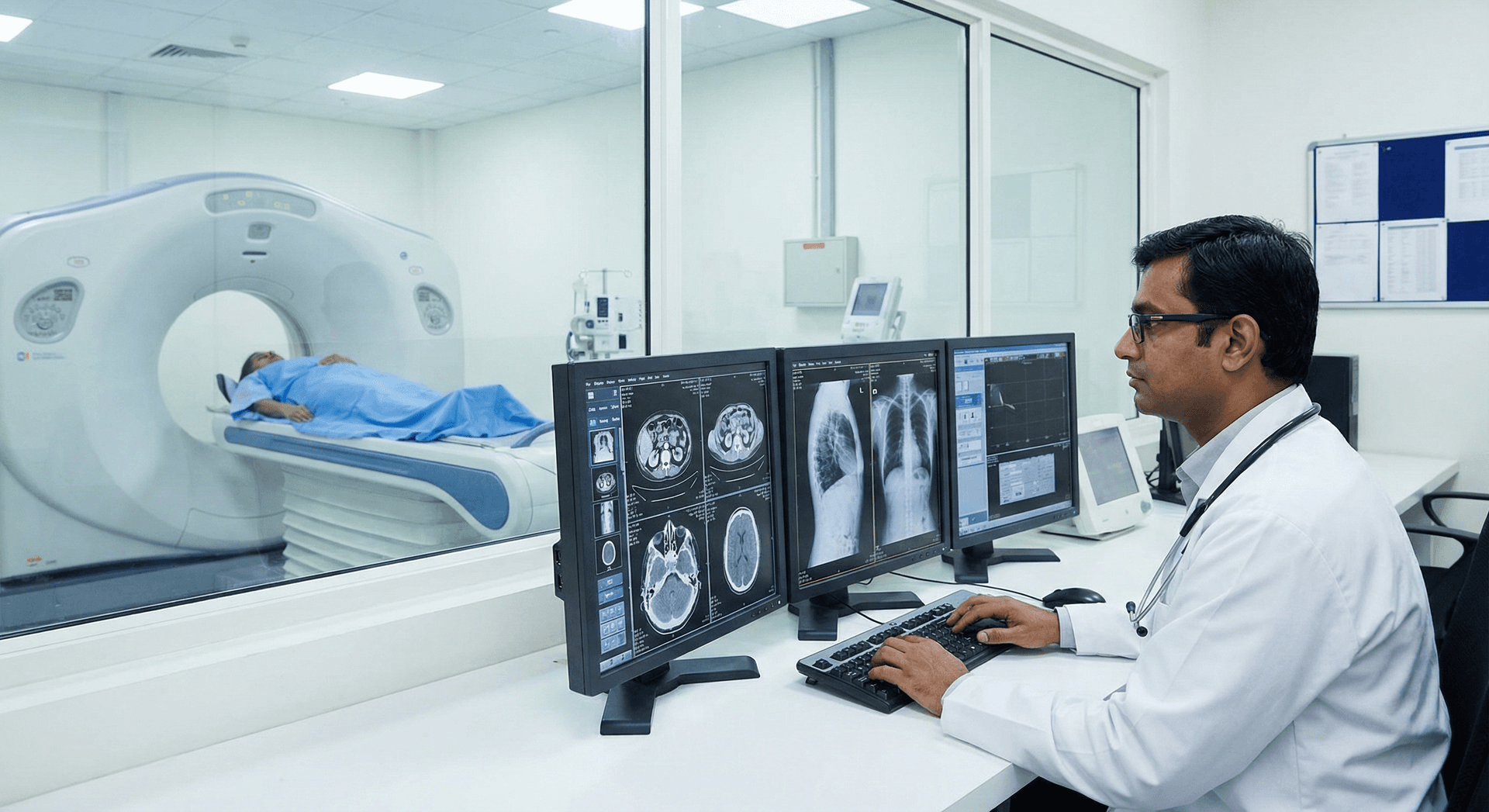
CT: 1–5 minutes; you slide through a short ring. Quick and well tolerated. Most patients find it easy.
-
MRI: 20–45 minutes; you lie in a tunnel. Can trigger claustrophobia. At Magnus, we use wide-bore MRI and allow a relative to stay with you to reduce anxiety. I've helped many claustrophobic patients through this—we have solutions.
Metal Implants: MRI vs CT
-
MRI: Metal can attract, heat, or distort images. Pacemakers, aneurysm clips, and some cochlear implants may exclude you. Most joint replacements and stents are MRI-safe; the team will verify. Don't assume you can't have MRI—ask us.
-
CT: Metal causes streak artifacts but doesn't exclude the scan. CT is often used when MRI is contraindicated.
Summary
MRI excels at soft tissues (brain, spine, joints) and uses no radiation. CT is faster, better for bones, lungs, trauma, and emergencies. Your doctor chooses based on your condition, urgency, and safety. Both are available at Magnus Diagnostics.
Need an MRI or CT? Call +91 89031 01010 or visit our MRI or CT scan pages to book at Irinjalakuda, North Paravur, or Pullur. We'll help you get the right test at the right time.