I can't count the number of times a patient has said, "Doctor, I already had an X-ray — why do I need a CT now?" It's a fair question, and one I hear almost daily at our imaging centres in Thrissur.
The truth is, X-ray and CT scan aren't interchangeable. They're different tools for different jobs. Think of the X-ray as the quick snapshot—fast, cheap, low radiation, perfect for simple problems. The CT scan is the detailed investigation—more information, more radiation, more cost, but sometimes absolutely necessary.
Let me explain when we use each, and why your doctor might recommend one over the other.
The Basic Difference: A Simple Analogy
Imagine you're looking at a loaf of bread. An X-ray shows you the whole loaf from the outside—you can see its shape, maybe some dark spots, but you can't see what's inside each slice. A CT scan cuts that loaf into thin slices and shows you each one. You can see exactly where a problem is, how deep it goes, and what's around it.
X-ray: Single beam, flat 2D image. Fast, cheap, low radiation. Great for bones, basic chest views, simple fractures.
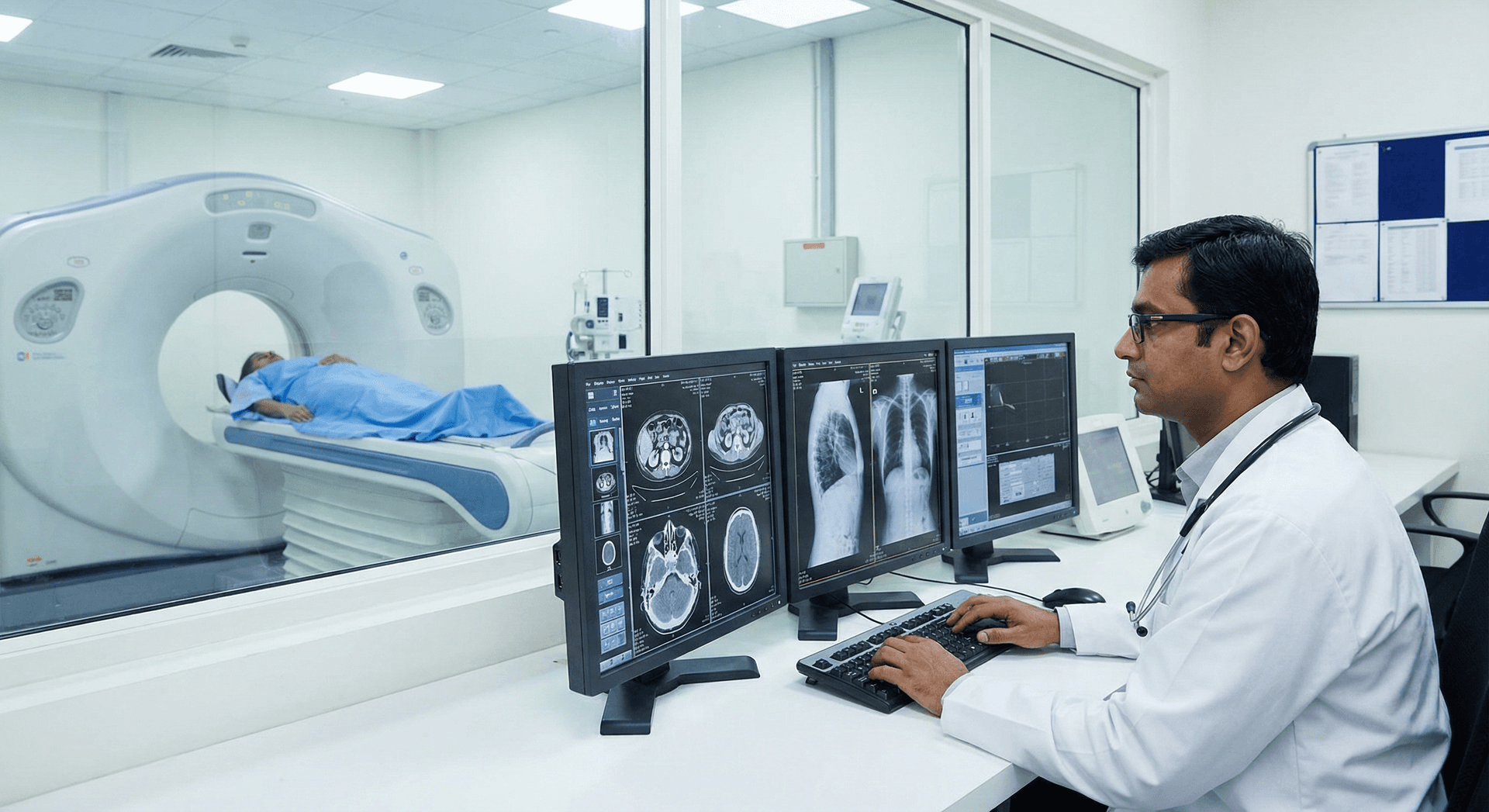
CT scan: Multiple X-ray beams from different angles, computer-processed into 3D cross-sections. More detail, more radiation, higher cost. Shows soft tissues, complex anatomy, small lesions.
When X-Ray Is Enough: The Quick Answer
In my practice at Magnus Diagnostics, X-ray is often the first test we do. It's fast—takes 1–2 minutes—and gives us enough information for many common problems.
For Bones and Joints:
- Simple fractures (we can see if a bone is broken and how it's aligned)
- Dislocations
- Checking bone alignment after treatment
- Basic arthritis assessment
- Screening for spine curvature (scoliosis)
For the Chest:
- Pneumonia (we can see the infection in the lungs)
- Pleural effusion (fluid around the lungs)
- Heart size
- Rib fractures
- Follow-up of known lung conditions
For the Abdomen:
- Bowel obstruction (we take two views—standing and lying down)
- Large kidney stones
- Foreign bodies
Other Uses:
- Dental imaging (OPG)
- Basic sinus views
- Pre-employment screening
At our centres, digital X-ray starts from ₹300 and is available as a walk-in—no appointment needed. We have X-ray facilities at Irinjalakuda, North Paravur, Pullur, and Ashtamichira.
When CT Is Necessary: The Detailed Investigation
Here's where I see patients get confused. Sometimes an X-ray shows something suspicious, or it doesn't show enough detail. That's when we need CT.
More Detail Required:
- Complex fractures (spine, pelvis, face)—CT shows exactly how the bone is broken and if fragments are displaced
- Small or subtle lung nodules—X-ray might miss them; CT finds them early
- Detailed abdominal anatomy (liver, pancreas, spleen, kidneys)—CT shows these organs clearly
- Small kidney stones in the ureter—X-ray only shows large stones
- Appendicitis, abscesses—CT is very accurate for these
- Bleeding (brain, abdomen)—CT shows active bleeding immediately
Vascular Studies:
- CT angiography (checking blood vessels for blockages, aneurysms)
- Pulmonary embolism (blood clots in the lungs)
Trauma and Emergencies:
- Head injury (checking for bleeding, fractures)
- Multi-organ trauma (one scan shows everything)
- Acute abdomen (severe abdominal pain of unknown cause)
When X-Ray Is Unclear: Sometimes structures overlap on X-ray, or bowel gas obscures what we need to see. CT eliminates that problem by showing cross-sections.
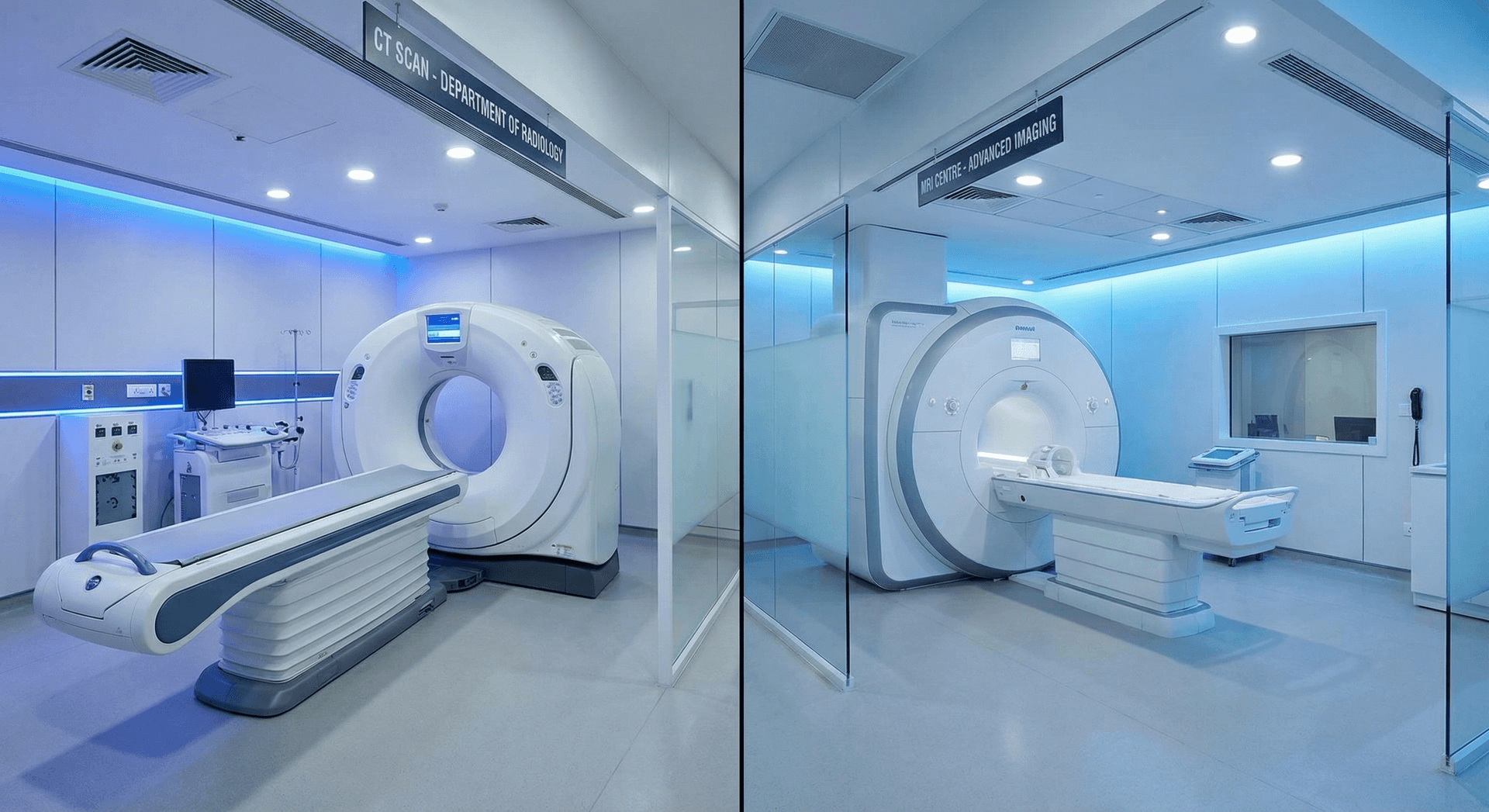
At Magnus Diagnostics, we use Ultra Low Dose 64-slice CT scanners at North Paravur and Pullur. These machines reduce radiation by up to 40% compared to older scanners—we get the detail we need with less exposure.
Radiation: The Real Concern
This is what patients worry about most, and I don't blame them. Let me put it in perspective:
A chest X-ray exposes you to about 0.1 mSv—roughly equivalent to 10 days of natural background radiation. A skull X-ray is similar at about 0.1 mSv. A chest CT, by comparison, delivers about 7 mSv, equivalent to roughly 2 years of background exposure. An abdomen CT is higher at around 10 mSv, similar to 3 years of natural radiation. A head CT falls somewhere in between at about 2 mSv, equivalent to roughly 8 months of background exposure.
Yes, CT uses more radiation than X-ray. But here's what I tell patients: a single CT scan, when medically indicated, is safe. The benefit of getting the right diagnosis far outweighs the small risk. We don't order CTs casually—we use them when we need the detail.
The concern is cumulative dose—repeated CTs over time. That's why we use low-dose protocols whenever possible and only order CTs when necessary.
A Real Example: Chest X-Ray vs Lung CT
Let me give you a scenario I see often. A patient comes in—maybe a smoker, maybe not—with a persistent cough. We start with a chest X-ray. It shows the lungs, heart, ribs. If there's obvious pneumonia or a large mass, we see it.
But what if the X-ray is normal, and the cough persists? Or what if there's a tiny shadow we're not sure about? That's when we need CT. CT can find small nodules—early lung cancers, for example—that X-ray would miss. It shows the detailed anatomy of the lungs, blood vessels, lymph nodes.
The X-ray costs ₹300 and takes 2 minutes. The CT costs more and uses more radiation, but if there's a problem, CT will find it.
Cost Comparison: What You'll Pay
Digital X-ray starts from ₹300 at our centres—it's a walk-in service, and the exact price depends on which body part we're imaging. CT scans vary more widely, typically ranging from ₹3,000 to ₹8,000 or more depending on the protocol and body part being scanned.
When X-ray is clinically adequate, it saves you cost and radiation. When CT is needed, the extra information justifies the higher price. Your doctor chooses based on your specific condition—not cost, but what's medically appropriate.
Special Considerations: Pregnancy and Children
Pregnancy: We avoid X-rays and CTs during pregnancy unless absolutely essential. If an X-ray is necessary, we shield the abdomen. CT is avoided unless it's critical—the radiation risk to the fetus isn't worth it for routine imaging.
Children: We use age-appropriate low-dose protocols. X-ray is preferred when possible, but CT is used when necessary—like head injuries or complex fractures.
Always tell our staff if you are or might be pregnant. We'll take extra precautions.
The Bottom Line
X-ray and CT scan are both valuable tools, but they're not the same. X-ray is fast, cheap, low-radiation—perfect for simple problems and screening. CT gives us detailed 3D images—essential when we need to see soft tissues, complex anatomy, or small lesions.
Your doctor doesn't choose randomly. If they recommend CT after an X-ray, it's because they need more information. Trust their judgment—they're balancing what we need to see against cost and radiation exposure.
At Magnus, we make both available. X-ray starts from ₹300 at all our centres. CT is available at North Paravur and Pullur with our low-dose scanners.
Need an X-ray or CT? Call us at +91 89031 01010 or visit our X-ray or CT scan pages. We're here to help you get the right test at the right time.